Hub / Heated mattress pads
Heated mattress pads
A pad goes under the fitted sheet and heats upward. Warmer to get into, invisible when made, and exactly one maker in six publishes what it draws.
Start with the best heated mattress pads. Deciding between a pad and a blanket? We compared them directly, and worked out whether a pad is worth it at all. Looking at Sealy specifically? The review is here. Buying for a single bed? Twin and full pads is where the two published wattages are. Buying for the longest bed? California king pads are a different rectangle from king, and a king pad will not fit.
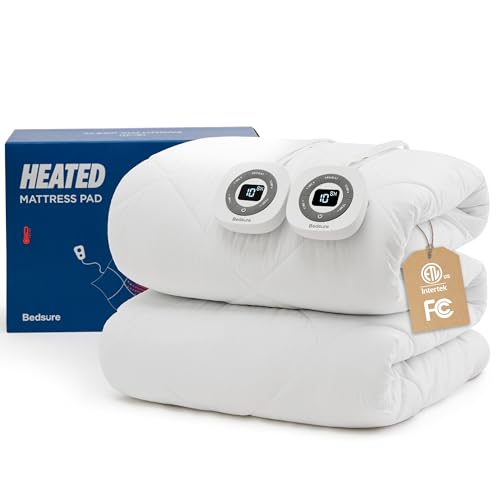
Top pick in this section: Bedsure Heated Mattress Pad, Queen
We earn a commission on some links here, at no extra cost to you. It does not change what we recommend or the order the picks appear in. How we are funded.
Everything in heated mattress pads
Roundups first, then the head-to-head comparisons, then the guides.
Roundup / Best overall pad
The best heated mattress pads
Six pads compared, and the single brand that tells you what its pad draws.
Top pick: Bedsure Heated Mattress Pad, Queen
Roundup / Best dual zone
Dual control heated mattress pads
Two zones under one sheet, and the size threshold where dual control starts.
Top pick: Bedsure Heated Mattress Pad, Queen
Roundup / Best waterproof
Waterproof heated mattress pads
Waterproof, water resistant and protector are three claims. Only one is a barrier.
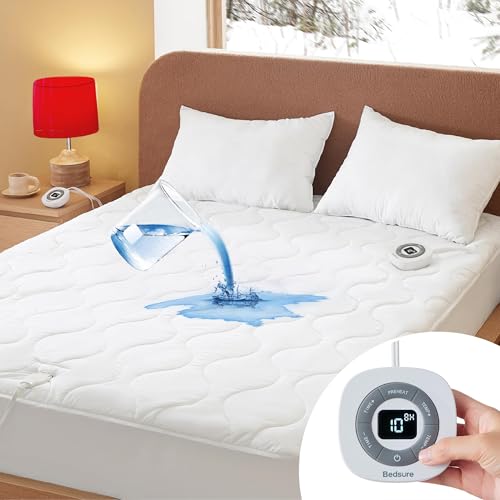
Top pick: Bedsure Waterproof Heated Mattress Pad, Queen

Roundup / Best king pad
King size heated mattress pads
Four king pads, one published wattage, and a five-year warranty worth noticing.
Top pick: Bedsure Heated Mattress Pad, King
Roundup / Shortest auto-off ceiling
Sealy heated mattress pad review
A deliberate nine-hour ceiling, two sizes that disagree, and no wattage on either.

Top pick: Sealy Heated Mattress Pad, Queen, Dual Control
Roundup / Best single-bed pad
Twin and full heated mattress pads
Four single-bed pads, two published wattages, and a listing that contradicts itself.

Top pick: Bedsure Heated Mattress Pad, Twin
Roundup / Best Cal King pad
California king heated mattress pads
Six inches narrower and four longer than a king, in the makers' own numbers.

Top pick: Valthie Heated Mattress Pad, California King
Guide
How to choose a heated mattress pad
Four specs in order, starting with the tape-measure question that returns pads.
Top pick: Bedsure Heated Mattress Pad, Queen
A heated mattress pad fits like a fitted sheet, under your bedding, and warms the mattress rather than the air. Of the twenty-one we track, five publish a wattage, all of them Bedsure: dual 100 W controllers at queen and king, 100 W at twin and 130 W at full. Eight hours with both zones on at queen is 1.6 kWh, about 29 cents at the current US average rate.
Why people who dislike blankets like pads
The complaint about electric blankets is almost always the same: you can feel the wires, and the blanket adds weight on top of you. A pad removes both objections. It sits under the fitted sheet, so there is a layer of cotton between you and the element, and it adds nothing to the weight of your bedding.
It also warms differently. Heat rises, so a pad warms the whole bed from below rather than trapping air above you. In practice that means a pad is better at making a cold bed pleasant to get into, and a blanket is better at keeping a person warm who is already in one. Neither is superior; they solve different halves of the same problem, which is why the direct comparison is worth reading before you choose.
The four specs that decide it
- Pocket depth. Every pad here claims to fit an 18-inch mattress. If yours is deeper, or you already run a topper, measure before you buy: a pad that will not stay on migrates in the night and heats the wrong part of the bed.
- Dual zone or single. Queen and larger usually ship with two controllers. Serta and Valthie both state that dual control starts at queen; below that you get one. On a shared bed this is the single most important line on the listing.
- Auto-off ceiling. Sealy stops at nine hours. Sunbeam, Serta, Bedsure and Valthie all run to twelve. Nine is a feature if you want the bed off by morning and a limitation if you want it warm at seven.
- Waterproofing. Bedsure's cotton-top pad has a TPU layer. Sunbeam's is described as water resistant, which is a genuinely different claim. Serta sells its pad as a mattress protector as well as a warmer. If there is a child or a dog in the bed, this line is the purchase.
| Brand | Rated watts | Auto-off | Waterproofing |
|---|---|---|---|
| Bedsure (standard) | Dual 100 W at queen and king, 100 W twin, 130 W full | Up to 12 h | None |
| Bedsure (cotton top) | Dual 100 W | 12 settings | TPU layer |
| Beautyrest | Not published | 10 h | Scotchgard on one model |
| Sunbeam | Not published | 1-12 h | Water resistant |
| Sealy | Not published | 1-9 h | Not stated |
| Serta | Not published | 1-12 h | Sold as a protector |
| Valthie | Not published | 1-12 h | Not stated |
Quoted from each maker's own Amazon listing, checked 2026-08-31 and extended through 2026-09-21. Bedsure is the only brand in this category we found publishing any wattage at all.
Preheating, and why it is the feature that matters
Several pads here advertise a preheat function. It is worth understanding what it does, because it is the difference between a pad that costs you 29 cents a night and one that costs a good deal less.
A preheat cycle runs the element hard for a fixed period before bed, then steps down to a lower level for the rest of the night. Bedsure publishes its curve explicitly: two hours at level 6, then six hours at level 4. Because the element is only at its rated draw for part of the run, the actual overnight consumption is well below the rated-watts arithmetic. We publish the rated figure anyway, because it is the only number the maker stands behind and because we have not measured the duty cycle ourselves. We will not estimate one.
Questions people actually ask
- How much does a heated mattress pad cost to run?
- For the only pad with a published figure, Bedsure's dual 100 W controllers: eight hours with both zones on is 1.6 kWh, about 29 cents at the current US average rate. One zone alone is half that. Nobody else in this category publishes a wattage.
- Does a heated mattress pad go over or under the fitted sheet?
- Under the fitted sheet, directly on the mattress. That puts a layer of cotton between you and the heating element, which is exactly why pads feel less wire-y than blankets.
- Can you use a heated mattress pad with a memory foam mattress?
- Generally yes, with the pad on top of the foam, never underneath it. Memory foam insulates, so heat that has to travel up through it will not reach you well. We cover this in heated bedding on memory foam.
- Do heated mattress pads have dual controls?
- Usually from queen size up. Serta and Valthie both state that queen, king and California king ship with two controllers while twin and full ship with one. Check the size line, not just the brand.
Sources
Every specification on this page traces to a published manufacturer listing or a government data source. Where a maker publishes no wattage, we say so rather than estimating one.