Comparisons / Head to head
Electric blanket vs a hot water bottle
The cheapest heat in the house against the most consistent. A kettle boil costs about a third of a cent, and that is genuinely the whole running cost. Here is what it buys and where it stops.
We earn a commission on some links here, at no extra cost to you. It does not change what we recommend or the order the picks appear in. How we are funded.

A hot water bottle costs about 0.3 cents to fill (one liter boiled in an electric kettle) and holds useful heat for two to four hours, in one spot. A 100 W blanket costs about 15 cents for eight hours and stays at temperature the whole time, across the whole bed. Both are cheap; they are not interchangeable.
Costing the hot water bottle honestly
This is the one comparison on the site where the rival is so cheap that people assume the arithmetic is not worth doing. It is worth doing, because the number is smaller than most people guess.
Heating one liter of water from a cold tap to boiling takes a little over 0.09 kWh in theory. An electric kettle is close to 90% efficient at this because the element sits in the water, so call it about 0.1 kWh in practice for a full bottle.
That is a genuine saving and it is smaller than the headline suggests, because both numbers are tiny. The difference between a bottle and a blanket over a 120-night winter is roughly $14, which is less than the price of the bottle plus one replacement stopper.
The spec table
| Hot water bottle | Electric blanket | |
|---|---|---|
| Running cost | About 3 cents per fill | About 15 cents per 8-hour night |
| Duration of useful heat | 2-4 hours, declining continuously | The whole session, at a set temperature |
| Area warmed | One spot, roughly a hand span | The whole bed |
| Temperature control | One: as hot as boiling water, then cooling | 6 to 12 settings, held |
| Needs an outlet | No | Yes |
| Works in a power cut | Yes, if you can boil water | No |
| Auto shut-off | Physics | 2 to 12 hours |
| Main failure mode | Perishing rubber, leaks, scalding | Overheating from damaged element |
| Replacement interval | Manufacturers commonly advise every 2-3 years | Around 10 years |
Blanket figures from the published 100 W Westinghouse queen at $0.1834/kWh (EIA, June 2026). Bottle cost is our arithmetic from kettle energy, shown above.
What the bottle is genuinely better at
- Cost. Roughly a fifth of a blanket's running cost, and no purchase price to speak of.
- Targeting. It goes exactly where it hurts, which is why people reach for one with cramps or a sore back. A blanket cannot concentrate heat that way, and neither can it replace a heating pad.
- No outlet, no cord, no controller. It works in a tent, in a power cut, and anywhere a blanket cannot reach.
- Preheating a bed. Put one in twenty minutes before you get in and it does the same job as a blanket's preheat cycle for a fraction of a cent.
- Nothing to go electrically wrong. No element, no controller, no cord to fray. Its failure mode is a leak rather than a fire.
What the blanket is genuinely better at
- Duration. A bottle is meaningfully cooler after two hours and cold by morning. A blanket holds a set temperature for as long as its timer allows.
- Coverage. A bottle warms one spot. A blanket warms the whole bed, which is the actual complaint most people have.
- Control. Six to twelve settings against one, and the bottle's single setting starts near-scalding and falls from there.
- Not having to get up. The bottle needs refilling to keep working; the blanket does not.
- Two people. A dual-control blanket warms both sides independently. Two bottles is two bottles.
The safety comparison, which is not one-sided
People assume the electrical product is the risky one. The honest read is that both have a real, well-documented failure mode and they are different in character.
A hot water bottle is filled with water at or near boiling and held against skin. Rubber perishes with age and heat, and manufacturers commonly advise replacing a bottle every two to three years for exactly that reason. A split seam or a failed stopper delivers a large volume of very hot water onto a person in bed. That is a scald risk and it is why bottles carry an age-out interval at all.
A heated blanket's risk is overheating from a damaged element, and it is concentrated in old and mistreated blankets. Every recall in the CPSC database for this category is for that one hazard: see heated blanket recalls and what actually goes wrong.
Both risks share one aggravating factor, and it is the same one: age. A bottle past three years and a blanket past ten are both products whose material has been quietly degrading where you cannot see it.
The picks, with the numbers
Ranked on what the maker publishes, not on a score we invented. Tap a row for the full write-up, or go straight to the listing. Cost is 8 hours at the rated wattage and $0.1834/kWh.
| # | Product | Best for | Watts | Per night | Price |
|---|---|---|---|---|---|
| 1 |  Top pickWestinghouse Heated Blanket, Queen100 W stated on the listing, 10 heat levels and a 12-hour timer. The cheapest bed blanket to run of anything here that publishes a number at all. | The lowest published draw | 100 W | 15 cents | $84.99 - See it on Amazon |
| 2 | 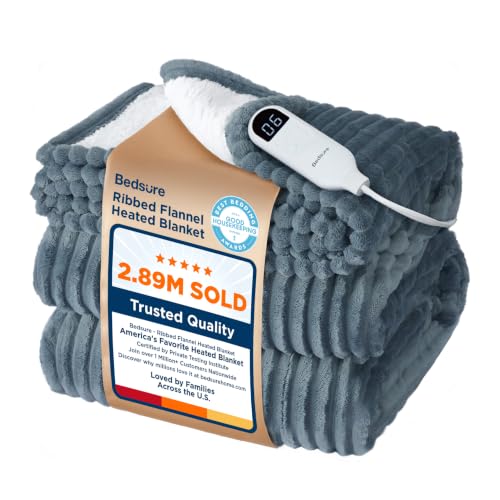 Bedsure GentleSoft Heated ThrowSame 100 W rating and 10-hour timer as the preheat throw, in a ribbed flannel finish. Bedsure states it "operates at just 100W". | The ribbed-flannel face | 100 W | 15 cents | $39.99 - See it on Amazon |
Sources: wattage from each maker's own published listing, cited on the card below. Cost is our arithmetic at the EIA rate, shown in full on cost to run.
#ad how we are funded - price as of September 19, 2026
The lowest published draw
Westinghouse Heated Blanket, Queen
Rated wattage
100 W
8 hours costs
15 cents
#ad how we are funded - price as of September 19, 2026
100 W stated on the listing, 10 heat levels and a 12-hour timer. The cheapest bed blanket to run of anything here that publishes a number at all.
Where the wattage comes fromWestinghouse states it directly in the first listing bullet: "a 100W, 60Hz heating blanket". This is a single-controller queen, so 100 W is the whole blanket rather than one side of it.
100 W x 8 h = 0.80 kWh, x $0.1834/kWh = $0.15 per night
- Size
- Queen, 84" x 90"
- Heat settings
- 10 levels
- Auto shut-off
- 1-12 hours, selectable
- Controllers
- 1
- Certification
- ETL and FCC certified
- Warranty
- Not stated on the listing
- Rated watts
- 100 W
- Voltage
- 120 V, 60 Hz
- Fabric
- Double-layer 200 GSM flannel
- Memory
- Yes, holds your last heat level
- Model
- KTHB-QAVV-Q
What it does well
- 100 W published, the lowest figure any queen here stands behind
- 10 heat levels and a timer selectable to any hour up to 12
- Memory function, so you are not resetting it every night
- Machine washable on cold, gentle
Where it falls short
- One controller only, so the whole bed runs at one temperature
- No warranty term on the listing
- Westinghouse's other queen listings do not publish a wattage, so the figure is model-specific
Who this is forA solo sleeper, or a couple who genuinely agree on temperature and want the lowest running cost on the page.
Skip it ifSkip it if you share a bed with someone who runs hot. There is one controller and no way to split the blanket.
The ribbed-flannel face
Bedsure GentleSoft Heated Throw
Rated wattage
100 W
8 hours costs
15 cents
#ad how we are funded - price as of September 19, 2026
Same 100 W rating and 10-hour timer as the preheat throw, in a ribbed flannel finish. Bedsure states it "operates at just 100W".
Where the wattage comes fromBedsure states the blanket "operates at just 100W" on standard 120V AC at 60Hz. Identical rating to the brand's other 50x60 throw.
100 W x 8 h = 0.80 kWh, x $0.1834/kWh = $0.15 per night
- Size
- 50" x 60"
- Heat settings
- 6 levels
- Auto shut-off
- Up to 10 hours (6 timer settings)
- Controllers
- 1
- Certification
- ETL and FCC certified
- Warranty
- Not stated on the listing
- Rated watts
- 100 W
- Voltage
- 120 V AC, 60 Hz
- Fabric
- Ribbed flannel with sherpa reverse
- Safety testing
- 74 in-house safety tests stated by the brand
- Model
- BS-100T
What it does well
- 100 W published
- Ribbed flannel face if you dislike flat microplush
- ETL and FCC certified
- Machine washable with the controller detached
Where it falls short
- Functionally the same blanket as the preheat model, without the preheat
- 6 heat levels
- No warranty term stated
Who this is forSomeone who prefers the ribbed texture and does not need the preheat cycle.
Skip it ifSkip it in favor of the preheat version. Same rating, same price bracket, one more useful feature.
The verdict
Buy the bottle if you want the cheapest possible warmth, you need it targeted at one spot, or you need it somewhere with no power. It is genuinely excellent at all three and costs almost nothing to run.
Buy the blanket if the complaint is a cold bed all night rather than a cold half hour, or if two of you need warming. Fifteen cents against three is not the deciding factor at these amounts, and duration and coverage are.
And the answer a lot of households actually want is both: a bottle to preheat the bed for almost nothing, and a blanket for the nights that stay cold. They cost so little to run that treating them as rivals is mostly a false economy.
Questions people actually ask
- Is a hot water bottle cheaper than an electric blanket?
- Yes. Boiling a liter costs about 1.8 cents at the US average rate, so a full bottle is roughly 3 cents against about 15 cents for an eight-hour night under a 100 W blanket. Over a 120-night winter the difference is roughly $14.
- How long does a hot water bottle stay warm?
- Two to four hours of useful heat, declining continuously from the moment you fill it, and cold by morning. That is the main practical difference from a blanket, which holds a set temperature for as long as its timer runs.
- Is a hot water bottle safer than an electric blanket?
- Not straightforwardly. Both have a real failure mode: a bottle can split or leak boiling water, which is why makers commonly advise replacing one every two to three years, and a blanket can overheat if the element is damaged. Age is the aggravating factor for both.
- Can I use a hot water bottle to preheat the bed instead of a blanket?
- Yes, and it is one of the cheapest things you can do. Put one in twenty minutes before bed and it does much the same job as a blanket's preheat cycle for a fraction of a cent. What it will not do is keep the bed warm until morning.
Sources
Every specification on this page traces to a published manufacturer listing or a government data source. Where a maker publishes no wattage, we say so rather than estimating one.
Read next
- Are heated blankets worth it?About 15 cents a night against a $2.20 space heater, plus the four cases where the answer is no.
- Cost to runSourced watts, a cited US rate, and the arithmetic shown for every figure.
- Heated blanket vs heating padLarge and gentle for hours, or small and hot for twenty minutes. Not substitutes.
- Heated blanket recallsFourteen CPSC notices, three failure mechanisms, and how to check your own in two minutes.